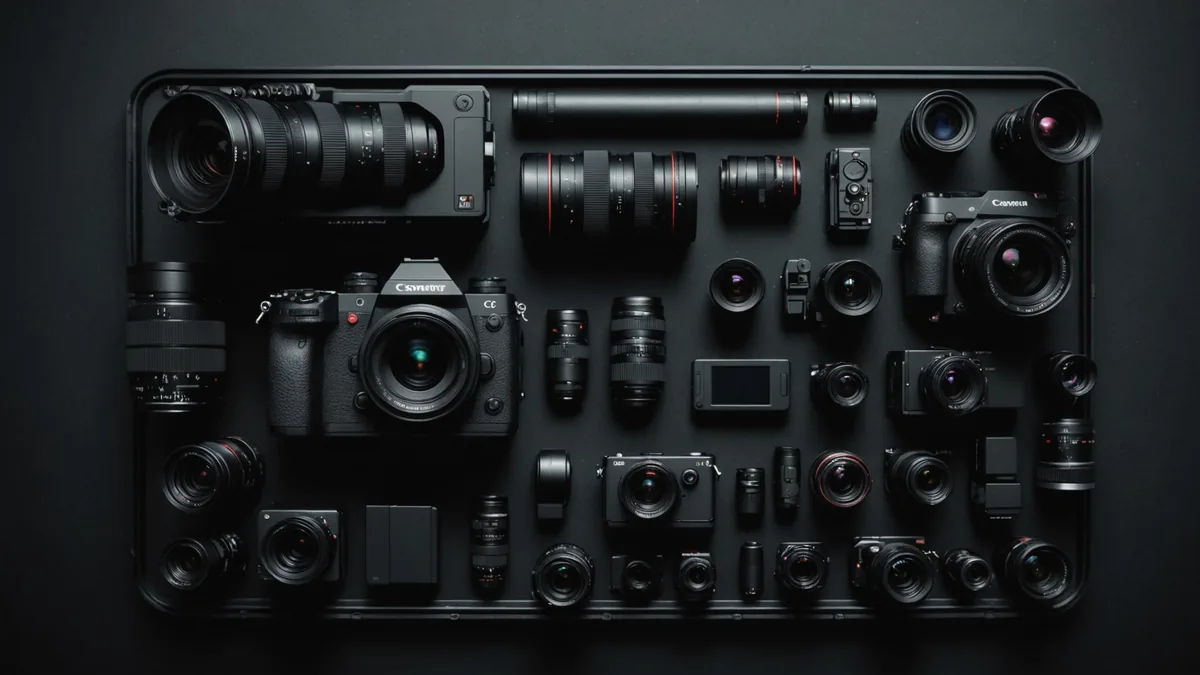
Run-and-gun shooting is a specific mode of production that has almost nothing to do with maximum image quality and almost everything to do with staying mobile, staying fast, and not missing the thing that's happening in front of you. The gear decisions for a run-and-gun kit follow from that logic — and so does the question of what to cut when the rental budget is tight.
This piece is about building a run-and-gun rental kit that does the job without overspending. Not a budget kit in the sense of compromising the work — a kit that's appropriately scoped for what run-and-gun production actually needs.
What run-and-gun production actually requires
Before talking gear, it's worth being clear about what the mode demands:
You're shooting in environments you don't fully control. Lighting changes, subjects move unpredictably, locations are improvised. Your setup time is measured in minutes, sometimes in seconds. You'll often be operating camera and monitoring audio simultaneously. Weight matters because you're carrying the kit, not a loader. The shot you almost got is the story.
This mode favours: compact camera bodies, flexible lenses that cover a range of focal lengths, on-camera microphones or a single clip-on, and support that doesn't require a C-stand and sandbags to stabilise. It doesn't require a large-format sensor, cinema primes, a full audio cart, or anything that needs two people to carry.
The camera body: what you actually need
For run-and-gun work, the camera body decision is largely about ergonomics, codec, and low-light performance — not maximum dynamic range or the widest possible colour gamut. You want something you can pick up and shoot with in five seconds without reconfiguring the build.
Strong options in the current rental pool:
Sony FX3 or FX30. Both bodies are designed around this exact use case. Full-frame sensor (FX3) or APS-C (FX30), 4K, excellent low-light capability, built-in ND filters on the FX3, and a compact form factor that works well handheld or on a lightweight cage. The FX3 rental rate sits around 800–1,200 DKK/day; the FX30 is typically 500–700 DKK/day on Wedio.
Blackmagic Pocket Cinema Camera 6K. Outstanding image quality for the price point, but the ergonomics are not built for documentary-style shooting — the battery life is poor, the form factor doesn't sit naturally in hand, and it benefits from a cage and external monitor that add weight and setup time. It's worth considering if image quality is the priority and you're prepared to accept the ergonomic trade-offs.
Sony ZV-E1. Full-frame, compact, and genuinely good in low light. Less capable as a dedicated video tool than the FX3 but lighter and more affordable. Works for solo documentary work where you're also handling other production duties.
One honest boundary: image quality between these cameras is real but often invisible in delivery. If you're distributing on the web or social platforms, the codec and colour science differences between an FX30 and an FX3 are not what determines whether the work is good. Spend the budget where it changes the outcome — usually lighting and audio, not an extra 400 DKK/day on the camera body.
Lenses: one or two, not a full set
For run-and-gun work, a full prime set is a liability. You don't have time to change lenses between shots. What you need is one or two lenses that cover the range you'll actually use.
Option 1: a single zoom. A 24-70mm or 24-105mm equivalent gives you the range from wide interview to medium close-up without a lens change. The Sony 24-105mm f/4 G or Tamron 28-75mm f/2.8 are both capable enough for documentary work. The limitation is that f/4 zooms need more light than f/1.4 primes. If you're working in low-light environments, factor in whether a fast prime covers your scenario better.
Option 2: two fast primes. A 24mm or 28mm wide and a 50mm or 85mm for tighter compositions. This covers most situations without carrying a full set. Canon EF 24mm f/1.4, Canon EF 85mm f/1.8 — both available at modest rental rates and well-suited to this kind of work. Changing between two is manageable in a way that changing between five isn't.
Skip: cinema primes, anamorphic glass, or anything with a significant front-element diameter that requires a matte box. These are not run-and-gun tools.
Audio: the part of the kit that gets cut too aggressively
Audio is where run-and-gun budgets get squeezed in a way that hurts the work more than any other cut. The instinct to rent a top-end camera body and use the built-in mic is exactly backwards. Bad audio is less fixable in post than flat colour. It's also the fastest way to get work rejected by a client or festival.
Minimum viable audio for a run-and-gun kit:
A shotgun microphone on a camera-top mount. The Rode VideoMic Pro+ or NTG5 both work well in this application. The NTG5 is lighter and designed for boom use but works equally well camera-mounted. Combined with a short furry windshield (or the Rycote Lyre mount system), this covers outdoor and indoor speech intelligibly.
A lavalier for interviews. A Rode Lavalier II or Sennheiser ME2 going into the camera's second audio channel, or into a small mixer feeding the camera. When you're doing a formal interview — even an improvised one — a camera-top shotgun at three metres of distance will pick up room reflections that a correctly placed lav won't. You don't need a Sound Devices MixPre-3 for a two-day solo documentary. A Zoom F2 recorder on the subject's belt is fine.
One honest note: monitoring audio while operating camera solo is genuinely hard. A good in-ear monitor connected to the camera's headphone output tells you whether you have signal and whether levels are clipping. Budget 15 minutes at the start of every shooting day to set input levels on the specific microphone and location, rather than trusting whatever setting you used last time.
Support: what you actually need versus what looks professional
A fluid head tripod is the one piece of support that's always worth including. Pan-and-tilt shots look significantly worse on a ball head. A compact fluid head — a Manfrotto 500 or similar — adds maybe 300–400 DKK/day to a rental and makes a meaningful difference to any sequence that includes camera movement.
Skip or defer:
- A shoulder rig. Useful if you're genuinely shooting handheld for long periods and need the stability. For most run-and-gun work, a good camera grip with a well-balanced cage is sufficient and faster to use.
- A slider. These require setup time and a stable surface. They're not a run-and-gun tool. Rent one if you have a half-day to dedicate to static beauty shots; don't include it in a kit where you'll be moving between locations every hour.
- A drone. Requires a separate operator, registration in Denmark under the national drone rules, and time to set up and land safely. Not a run-and-gun addition.
- A motorised gimbal. The DJI RS series gives good stabilised movement but requires time to balance for each new lens and body configuration. For a solo operator who is also monitoring audio and conducting interviews, it's often more work than it's worth. Save it for projects where the gimbal move is planned.
A run-and-gun kit that actually works
For a solo documentary or event shoot over two days, a sensible Wedio rental build might look like:
- Sony FX3 body — 1,000 DKK/day
- Sony 24-105mm f/4 G or equivalent zoom — 350 DKK/day
- Rode NTG5 with windshield — 200 DKK/day
- Zoom F6 or Zoom F2 personal recorder — 150 DKK/day
- Compact fluid head tripod — 300 DKK/day
- Spare batteries x2, appropriate media cards — often sourced with the camera
Total daily outlay around 2,000 DKK for a kit that covers serious independent documentary work. Two days of rental for a project gives you a budget that's genuinely lower than a single day at a hire house for comparable gear, with no minimum booking period.
The kit listed above won't produce the same image as an ARRI ALEXA Mini with a Cooke S4/i prime set. That's not what it's for. What it will do is let you shoot all day, react fast, capture clean audio, and come home with footage that tells the story — which is what run-and-gun production is actually for.