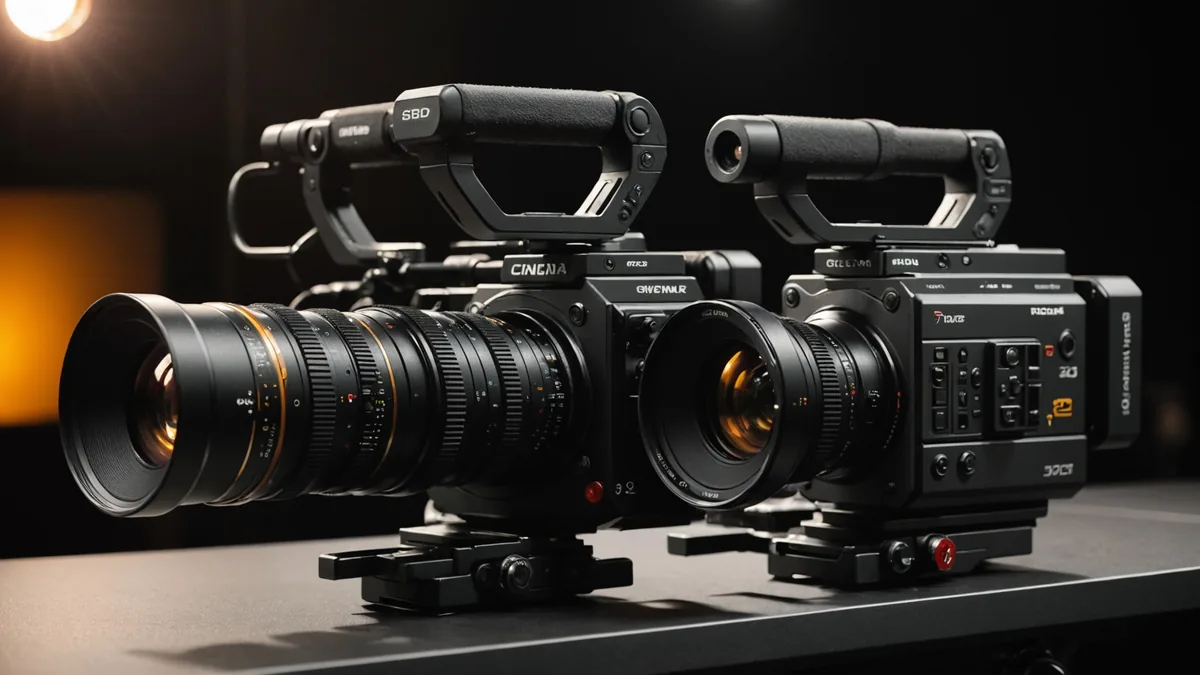
You've been shooting on a Sony A7S III or a Blackmagic Pocket and the results have been fine. Better than fine. But you've got a short film coming up, a music video, a documentary segment — something where "fine" isn't the goal — and you want to know what renting a proper cinema camera actually means in practice. Not the spec sheet. Not the YouTube comparison. What it means when you show up on set with a camera that behaves like a cinema camera.
This is that guide. We're going to walk through the decisions that actually matter before you book your first cinema camera rental: sensor size, codec, the lens mount situation, and what questions to ask before you confirm the booking.
Start with the sensor format, not the brand
Cinema cameras are sold under model names but they're really sold as sensor formats. The format determines your field of view crop, your depth of field range, and which lenses will cover the image circle. Getting this wrong before you book a lens package is a fast way to ruin your day.
The three formats you'll encounter most often at the accessible end of the rental market:
Super 35 (S35)
This is the historical cinema standard. Roughly the size of a 35mm film frame — about 24mm × 18mm in the digital world, though it varies by manufacturer. The ARRI Alexa Mini, RED Komodo, and Sony Venice all offer S35 as a shooting mode. S35 gives you a field of view very close to what the cinematographer saw when they designed the shot in their head. It also means a 50mm lens behaves like a 50mm lens. No mysterious crop factors.
Depth of field on S35 at T2.0–T2.8 is shallow but controllable. You're not fighting the optics; you're working with them.
Full-frame / Large Format
Full-frame sensors (36mm × 24mm and above) are increasingly common in cinema cameras. The Sony FX6 and FX9 shoot full-frame; so does the ARRI Alexa 35 in certain modes. Full-frame gives you shallower depth of field at any given aperture and a wider field of view from the same focal length — which means you need slightly longer lenses to match a traditional S35 composition.
If you're renting full-frame and pairing it with a lens kit designed for S35, check image circle coverage carefully. Most modern cinema primes cover full-frame, but some vintage glass doesn't, and you'll see corner vignetting or edge softness.
Micro Four Thirds (MFT) and S16
The Blackmagic Pocket Cinema Camera 6K Pro uses a Super 16 sensor. It's small, affordable to rent, and produces beautiful images — but the 2.88× crop factor means a 25mm lens behaves like a 72mm equivalent. You need wide-angle glass to get wide shots. Factor that into your lens budget when you're working out what the rental kit actually costs.
Codec and recording format: what you actually need
Cinema cameras record in proprietary raw formats, compressed raw, or heavily compressed log flavours. The differences matter for how much storage you'll burn through, how long your post pipeline will take, and how much colour latitude you'll have in the grade.
Raw is wonderful but expensive in storage and processing time. REDCODE RAW at 5:1 on a RED Komodo gives you beautiful latitude but you'll be working in DaVinci Resolve with proxy media, your colourist will need the RAW files at full size, and your card costs are real. For a five-day shoot, budget 2–3 TB of storage minimum. If you're renting the camera through a P2P marketplace, confirm whether media is included in the rental and what format the owner has configured the camera to record.
ProRes 4444 or BRAW (Blackmagic RAW) is often the right call for first-time cinema camera renters. Both give you substantial colour latitude in the grade without the full complexity of compressed raw workflows. BRAW on a Pocket 6K is particularly friendly — it records to standard CFast 2.0 or USB-C SSDs, playback is fast in Resolve, and the files are manageable sizes.
We're not saying raw formats are bad — far from it. We're saying that if you've never worked with raw cinema footage before, a five-day shoot is not the time to learn the workflow.
The lens mount question
Cinema cameras and cinema lenses come with a range of mounts: PL (the professional standard), EF, E-mount, and LPL on newer ARRI bodies. Most cameras are available with mount adapters, but adapters add a point of failure, can introduce focus breathing differences, and occasionally cause communication issues with electronic aperture control.
The practical approach for a first rental: decide which lens set you want first, then find a camera body whose native mount matches those lenses. If you want a set of Zeiss Super Speeds (PL mount), book a camera with a native PL mount or a trusted PL adapter. If you want to use Canon CN-E cinema primes because the owner has an EF-mount body available, book the EF mount body.
Where this gets complicated: the Cooke S4 set your camera owner lists as a PL package won't work on an E-mount Sony body without an adapter — and even with a reputable PL-to-E adapter, the register distance matters for infinity focus accuracy. Ask the owner directly about what mount configurations they're comfortable with before confirming.
What to actually ask when browsing listings
Good P2P listings will have condition reports with photos. Still, some questions are worth sending before you confirm a cinema camera booking:
- What recording media is included? Some owners include cards or SSDs; others don't. Cinema camera media costs (CFast 2.0, RED MINI-MAGs, CFexpress Type B) can add 800–2,500 DKK to your rental if you have to source them separately.
- What is the rated shutter speed and sensor age? For RED cameras specifically, ask whether the sensor has any known fixed pattern noise at high ISO. This is not a fabricated concern — some older EPIC/SCARLET sensors have it. For Blackmagic cameras, ask whether the owner has calibrated the sensor recently.
- Is a follow focus included? Cinema lenses have de-clicked, calibrated focus rings because they're meant to be pulled by a focus puller using a follow focus system. If you're operating solo, you need to think through your focus workflow. Renting the camera body without a follow focus and then discovering you can't smoothly operate the lens alone is a problem.
- What battery system? Most cinema cameras run on V-lock or Gold Mount batteries, not Sony NP-F series. V-lock chargers are not universal. Know what battery system comes with the rental and how many charged batteries you'll have at the start of day one.
The support and rigging reality
Cinema cameras are designed to be rigged. An ARRI Alexa Mini or a RED Komodo is not a run-and-gun camera in its natural state — it wants a baseplate, 15mm rails, a matte box, and either a shoulder mount or a tripod with a proper fluid head. A Sachtler aktiv.8 head or equivalent is the right partner for these bodies.
If you're planning to handheld a cinema camera, you need a proper cage and handles, and most cinema camera rigs weigh between 5 and 12kg fully loaded. Know that before you plan a shooting day with 10 setups and no camera operator support.
On Wedio, many cinema camera listings include a baseplate or cage. Check what's listed and what you'd need to add — a good rig is often available from the same owner or from another lister nearby.
A practical first rental scenario
Here's a realistic starting configuration for a first cinema camera rental on an independent short film: Blackmagic Pocket Cinema Camera 6K Pro (S16 sensor, EF mount, built-in ND) + a set of Samyang/Rokinon cine primes (EF mount, 24mm/35mm/50mm/85mm), recording BRAW 5:1 to a fast USB-C SSD, on a Smallrig cage with wooden handles. The Pocket 6K Pro has a built-in SSD slot for a Samsung T7 or similar, so no proprietary media required.
Total rental cost in Copenhagen for a three-day shoot: realistically 2,800–4,500 DKK depending on availability and what's included. That's a far cry from what a hire house charges for a "small cinema camera package," and for an independent short film, the image quality is more than sufficient.
The step up from there — moving to a Sony FX6, RED Komodo, or ARRI Alexa Mini body — is a real step, in price and in workflow complexity. Don't let the spec sheet ambition run ahead of your actual production needs. The camera that gets used well beats the camera that gets rented and then fought with.
Before you book: the self-check
Run through this before confirming any cinema camera rental:
- Do I know what sensor format this body shoots and what that means for my lens choices?
- What recording format will I use and am I set up to handle those files in post?
- Does the lens mount on the body match the lenses I've also booked?
- Is recording media included or do I need to source it separately?
- What support equipment do I need and is it included or separately bookable?
- Have I done a test recording the night before the shoot to confirm the camera is working and I understand the menu system?
That last one is non-negotiable. Picking up a camera at 8am and shooting at 9am on a rented cinema body you've never touched before is asking for trouble. Pick up the night before if the owner allows it, spend an hour with the menu, record a test clip, check the output on a monitor. The 45 minutes you spend on that the evening before is worth more than any extra setup prep on the day.