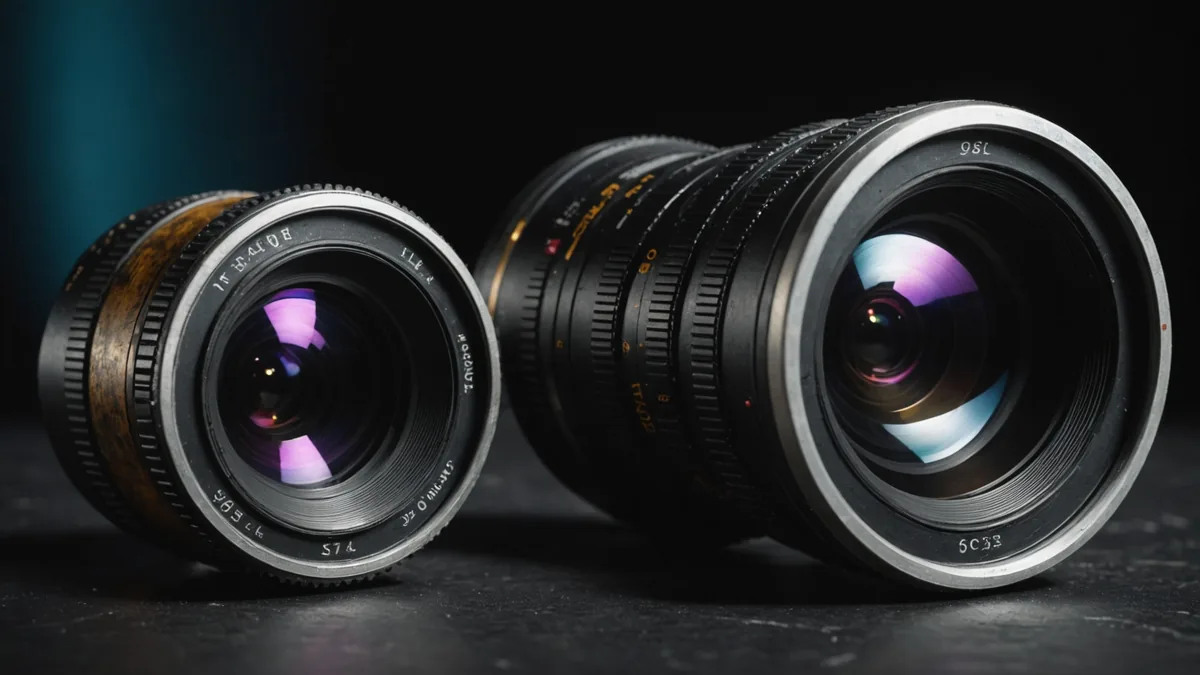
The word "character" gets thrown around so much in cinematography discussions that it's lost most of its meaning. Someone will say a vintage set has character and what they mean is: it has some combination of reduced micro-contrast, spherical aberration at wide apertures, focus breathing, and optical distortion that makes the image look different from modern glass. None of those are value judgements. Whether those characteristics help or hurt your image depends entirely on what you're trying to do.
This guide is for filmmakers renting lenses and trying to decide between a modern cinema prime set and a vintage set — not as an aesthetic preference exercise, but as a practical decision for a specific project. We'll cover what the optical differences actually are, when vintage glass helps you, and when it's a liability.
What modern cinema primes actually do
Modern cinema primes — Cooke S4/i, Zeiss CP.3, Canon CN-E, ARRI/Zeiss Master Primes, Leica Summilux-C — are designed to a consistent optical brief. That brief is, roughly: maximum sharpness from corner to corner even at wide apertures, consistent colour rendition across the set, minimal focus breathing, minimal distortion, and parfocal design so the focus point doesn't shift as you change focal length during a pull.
The consistency of a modern set is its main value proposition. On a multi-camera shoot, or any shoot where you're intercutting heavily between focal lengths, that consistency means the colourist doesn't have to compensate for the 35mm looking different from the 50mm. For commercial work, episodic television, or any context where the image needs to feel polished and controlled, modern glass is the correct choice.
Modern primes also tend to have T-stop markings — calibrated transmission, not geometric aperture — making exposure matching across focal lengths much simpler. The Zeiss CP.3 set is consistent across the full range to within roughly 1/3 stop. That matters when you're shooting a dialogue scene and cutting between a 35mm on the wide and an 85mm on the close-up. The exposure is the same at T2.1 on both lenses, so your exposure stays consistent before you've touched the grade.
What vintage glass actually does — technically
When cinematographers talk about vintage glass character, they're describing several overlapping optical phenomena that modern glass specifically engineers away.
Spherical aberration and halation
Vintage lenses — pre-1980s and sometimes into the 1990s — use spherical lens elements rather than the aspherical elements common in modern cinema glass. Spherical elements don't bring all wavelengths of light to the same focus point at wide apertures. The result is a soft, glowing quality around specular highlights, particularly at the edges of the frame. This is commonly called "halation," though technically the glowing quality is spherical aberration rather than true halation (which is a film stock artefact).
On a dark background with practical lights in frame — a scene in a bar, a street scene at night — this creates a particular look: highlights bloom gently, edges of the frame fall soft, the image feels less clinical. On a clean interior in daylight with controlled lighting, the same aberrations can read as muddy or smeared, depending on the scene.
Reduced micro-contrast and veiling flare
Vintage glass, particularly uncoated or single-coated glass from the 1950s–70s, has reduced micro-contrast compared to modern multi-coated glass. The effect: images look a touch lower in contrast overall, shadow detail can muddy slightly, and veiling flare — a general contrast reduction across the whole image when there's a bright source near or in frame — is much more pronounced.
Zeiss Super Speeds (PL mount, late 1970s–80s) are a commonly rented set that sit at an interesting middle point. They're partially multi-coated, so they don't flare wildly, but they have the classic Super Speed rendering — slightly reduced contrast wide open at T1.3, a particular quality that nothing modern replicates exactly.
Focus breathing
As you rack focus on a vintage lens, the field of view changes slightly. Pull from 1m to 3m on a 50mm vintage lens and the image appears to zoom out slightly as focus travels to infinity. Modern cinema primes are specifically designed to minimise this, because focus breathing is visible during focus pulls and distracting in post-production if you're compositing or have a wide-screen composition that depends on a stable frame.
For documentary work or interview scenarios, breathing doesn't matter much — you're rarely pulling focus dramatically within a locked shot. For narrative fiction where focus is being pulled on moving subjects and the shot is closely composed, breathing can be genuinely problematic.
When to choose vintage glass
Vintage glass works best when: you want a period feel, you're shooting interiors with practicals in frame and want the halation as part of the aesthetic, you're doing portraiture or intimate documentary work where the slight softness flatters faces, or you're deliberately working against a hyper-clean look that would feel wrong for the subject matter.
Filmmakers working on music subculture documentaries, intimate interview pieces shot in industrial or raw spaces, or narrative shorts set in the past routinely choose vintage glass because the optical character supports the story. When the rendering is clearly intentional, it reads as a choice. When it's accidental, it reads as a limitation.
When to choose modern glass
Modern cinema primes make your life simpler in almost every technical dimension. The consistency is easier to colour grade. The T-stop accuracy makes multi-lens exposure matching simpler. The minimal breathing is better for precise composition. The coatings make your lighting setup more predictable — the image responds to the light the way you planned, rather than introducing veiling flare when you didn't want it.
For a first cinema camera rental paired with a first cinema lens set, a modern set like Zeiss CP.3 XD or Canon CN-E is a genuinely better learning environment. You're dealing with fewer variables. The lens is doing exactly what you tell it. When something doesn't look right, you know the lens isn't compensating or adding something unpredictable. That's valuable when you're still building your eye for what you want the image to do.
The set consistency issue that matters most
Here's the thing we'd push back on most in the vintage versus modern debate: it almost always ignores the single most practically important variable, which is set consistency. A properly matched set of Zeiss Super Speeds — all from the same period, serviced together, with consistent coating — will cut together beautifully. A mismatched collection of "vintage" lenses from three different manufacturers and three different decades won't, regardless of how good each individual lens looks.
When you're browsing on Wedio, look carefully at whether the vintage set being offered is actually a matched set. A listing that offers "Leica R vintage primes, 35mm/50mm/90mm" is not the same as "Cooke Speed Panchros matched set." The former is three lenses from potentially different production runs that will have inconsistent rendering. The latter is a set designed and calibrated to cut together.
If you're renting a vintage set and the owner can't tell you whether the lenses have been matched or serviced together, that's important information. It doesn't mean the lenses are bad — it means you're taking on rendering inconsistency as a risk, and you should be aware of that going in.
Practical consideration: mount availability
Most cinema vintage sets are PL mount. Zeiss Super Speeds, Cooke Speed Panchros, Hawk V-series, and the majority of anamorphic sets are PL. If you're renting a camera with an EF or E-mount and want to use a PL lens set, you need an adapter — and the adapter matters. A low-quality PL-to-EF adapter can introduce focus inaccuracies at infinity, mechanical play, or communication issues with the camera. Ask the owner whether they have a tested adapter they use regularly, or whether the lens set should be paired with a specific camera body.
Modern cinema primes come in EF, PL, LPL, and E-mount configurations, often with conversion kits. This makes them more flexible across different camera bodies, which is one more practical reason they're often the right choice for a first cinema rental package.
The honest bottom line
Vintage glass is not better than modern glass. Modern glass is not soulless. Both claims are aesthetic opinions dressed as technical facts. What is true: vintage glass adds optical variables that can contribute to a specific look, and those variables are easier to understand once you already know how modern, predictable glass behaves. If you've never shot a project on cinema primes before, renting a modern set first will teach you more about your own lighting decisions and colour choices — because the lens isn't adding its own voice to the image. Once you understand what you're looking at without the vintage character, adding it deliberately becomes a genuine creative decision rather than a mystery you're hoping works out.